
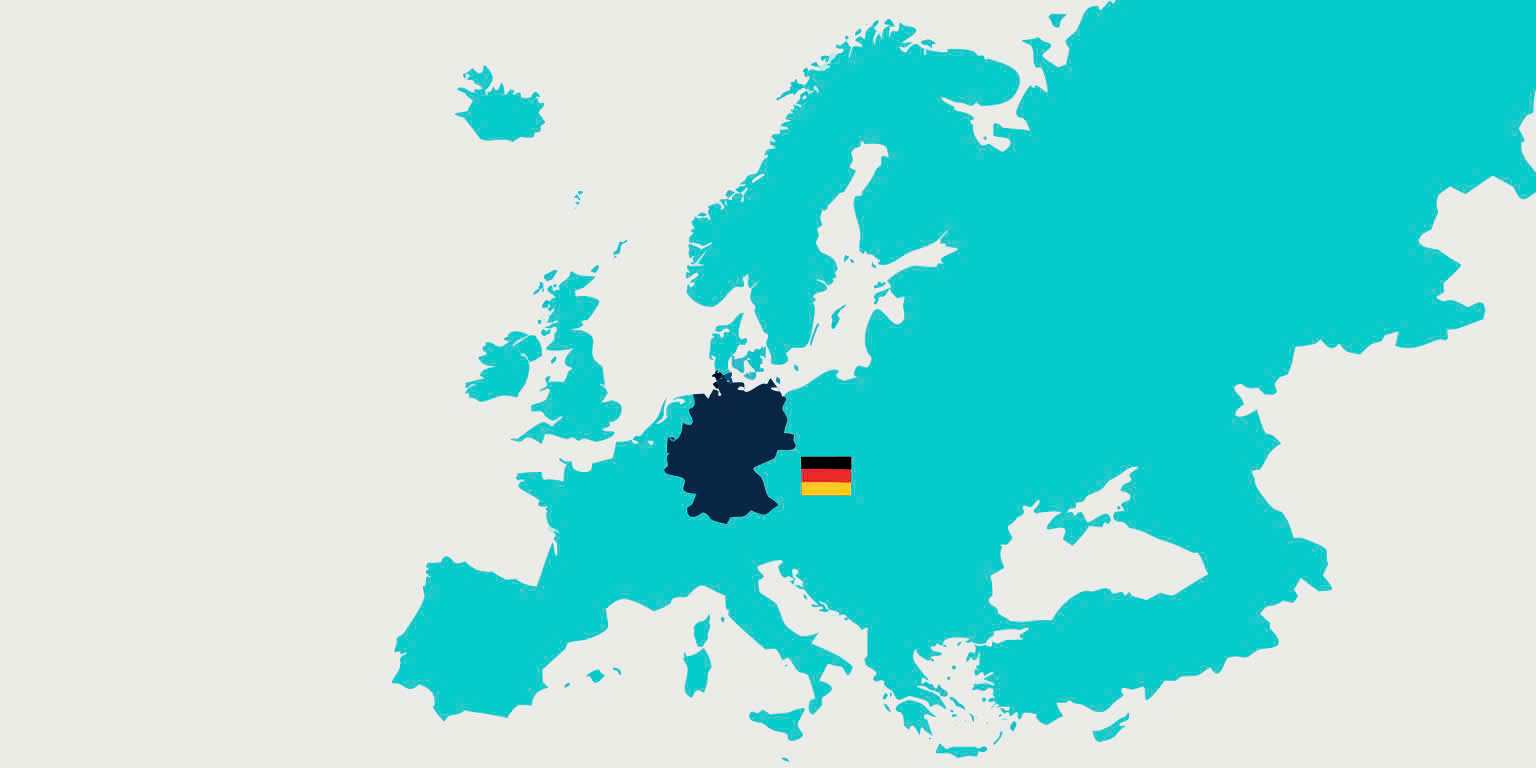
Germany faces a shortage of over 340,000 skilled tech workers, and international candidates applying remotely are increasingly the ones filling those roles.
In this article
- 1.Why Germany Is a Strong Target for International Candidates
- 2.The Lebenslauf: Germany's CV Format Explained
- 3.The Bewerbungsfoto: Professional Photo Standards
- 4.The Anschreiben: Germany's Cover Letter Culture
- 5.Certifications and Professional Culture
- 6.Where to Find German Remote Roles
- 7.Common Mistakes International Candidates Make
Germany has become one of the most strategically valuable markets for international remote workers, and the reasons extend well beyond its reputation for engineering precision. Berlin alone attracted over €4.5 billion in venture capital in 2024. Munich anchors a dense cluster of enterprise software, automotive tech, and medtech companies. Hamburg hosts some of Europe's most sophisticated e-commerce operations. Across all of these cities, German companies are actively hiring internationally, increasingly through remote arrangements that would have been unusual five years ago.
The opportunity is genuine, but it carries a specific challenge. German professional culture follows its own conventions, and the application process is governed by standards that differ sharply from US and UK norms. International candidates who submit a US-format resume without a photo, without an Anschreiben, and with year-only date ranges are, in the view of German recruiters, demonstrating immediately that they have not researched the market. The signal is both immediate and difficult to recover from.
This guide covers the complete picture: why Germany rewards the investment of proper preparation, how to format every element of your application correctly, which certifications carry the most weight, how German professional culture operates in remote environments, and how to avoid the mistakes that eliminate most international candidates before a recruiter finishes the first page.
Why Germany Is a Strong Target for International Candidates
Germany's structural talent shortage is not a temporary condition. The country has a deficit of over 340,000 qualified tech workers, driven by an aging domestic workforce, insufficient STEM graduate output, and a decade of underinvestment in digital transformation across both public institutions and Mittelstand companies. The government responded with the Fachkräfteeinwanderungsgesetz (Skilled Immigration Act), updated in 2023 and again in 2024, which created new pathways for international talent including specific provisions for remote work arrangements with German employers. The policy shift reflects a clear recognition: the gap cannot be closed from within Germany alone.
For remote roles, the landscape is especially favorable for prepared candidates. Companies like Zalando, N26, Delivery Hero, and Auto1 Group regularly hire engineers, data scientists, and product managers from across the EU and beyond through employer-of-record (EOR) arrangements that require no German work authorization. A backend engineer based in Bogotá applying to a Berlin fintech does not need to relocate, does not need a visa, and does not need to speak German, provided the role is English-language and genuinely remote. What the candidate does need is an application that meets German standards in every detail, because the benchmark for evaluation is always the local expectation, not the international one.
Germany's Mittelstand companies, the mid-size industrial and engineering firms that collectively form the backbone of the economy, are also increasingly open to international remote talent, particularly for software engineering, data analysis, and digital transformation roles. These companies receive far less attention from international candidates than the Berlin startup ecosystem, but they often offer more stability, more deliberate career development paths, and a stronger emphasis on craftsmanship and long-term thinking. They also have a stronger preference for formal credentials and structured application materials, making document quality even more consequential.
Key Takeaway
The Lebenslauf: Germany's CV Format Explained
The German CV, called a Lebenslauf (literally "life course"), follows a format that differs from an Anglo-American resume in several substantive ways. These are not stylistic preferences. They are specific conventions that German recruiters use as quality signals, and deviating from them without awareness marks an application as uninformed before its content is evaluated.
The Lebenslauf opens with a personal data header containing the candidate's full name, address, phone number, email address, date of birth, nationality, and marital status. This information is standard and legally expected in Germany, where anti-discrimination frameworks operate under different principles than in the UK or US. The professional photo belongs in the upper right corner of this first page. Below the header, the document proceeds in reverse chronological order, starting with the most recent position and working backward, with exact start and end dates expressed as month and year for every role.
Employment gaps require direct attention. German recruiters are trained to look for continuity, and any unaccounted period will prompt questions. Gaps should be labeled explicitly within the Lebenslauf itself, whether as "parental leave," "language study," "independent project work," or "health-related leave." Leaving a gap silent and hoping it passes unnoticed will not work with experienced German hiring managers. Addressing it proactively, by contrast, demonstrates precisely the kind of transparency and self-awareness that German professional culture values.
- Language proficiency: List all spoken languages with levels according to the Common European Framework of Reference (A1 through C2), including your native language at C2 and any language studied to a demonstrable level.
- Professional certifications: Include every relevant certification with the issuing body, full certification name, and date of completion, presented as a dedicated section rather than embedded in individual role descriptions.
- Hobbies and interests: Optional but genuinely common, particularly in Mittelstand environments; it signals well-roundedness and cultural engagement in a way that German hiring managers, especially outside Berlin's startup culture, authentically value.
Length is typically one to two pages. Unlike the strict one-page convention in the United States, a two-page Lebenslauf for an experienced candidate is fully appropriate and commonly expected. The goal is completeness within a clean structure, not compression at the expense of relevant information.
Key Takeaway
The Bewerbungsfoto: Professional Photo Standards
International candidates trained in US or UK career norms often instinctively omit a photo from job applications to avoid signaling information that could trigger bias. In Germany, this instinct works directly against the candidate. German recruiters expect a Bewerbungsfoto, and its absence is interpreted not as ethical awareness but as an incomplete application from someone unfamiliar with local standards.
A Bewerbungsfoto is not a headshot repurposed from a social profile or a cropped image from an event. German application photos have specific quality and presentation standards that professional studios across Germany are calibrated to provide. For candidates applying fully remotely, a well-composed photograph with controlled lighting and a neutral background serves as a fully acceptable substitute, provided it meets the same quality threshold.
- Background: Neutral in tone, white, light grey, or muted blue, with no distracting elements in the frame and consistent lighting across the image.
- Attire: Business or business-casual clothing appropriate to the industry; engineering roles allow smart casual, while finance, legal, and consulting roles call for formal business dress.
- Expression: Warm and professional, conveying confidence without the stiffness that comes from over-posing; the goal is to appear approachable and competent simultaneously.
- Technical quality: High resolution, well-lit, recent within the last two years, sized approximately 4.5 by 6 centimeters for placement in the upper right corner of the first page.
A professional photo communicates that the candidate understands German application culture and has invested in presenting themselves seriously. Its absence creates a gap that is difficult to overcome, regardless of the strength of the underlying qualifications.
Key Takeaway
The Anschreiben: Germany's Cover Letter Culture
The Anschreiben, Germany's equivalent of the cover letter, carries significantly more weight than its counterpart in most English-speaking markets. Many German job postings explicitly require one. Submitting an application without an Anschreiben, even when the posting does not specifically demand it, signals a lack of seriousness that German hiring managers consistently notice and consistently hold against a candidate.
The opening line must not be generic. Phrases such as "I am writing to apply for the position of" are recognized immediately as lazy and formulaic. German recruiters read hundreds of Anschreiben and can identify a template opening in seconds. The standard that earns attention is a specific, substantive reason for interest in this particular company: a reference to a product release, a recent funding milestone, a specific technical challenge the company is publicly working on, or a piece of their engineering blog that revealed something about their approach. A product manager based in Nairobi applying to a Munich-based fintech, for example, might open by referencing the company's recently announced expansion into pan-African payment infrastructure and explain why their background positions them to contribute to that specific initiative.
The body of an effective Anschreiben covers precisely two things: why the candidate is qualified, supported by specific evidence rather than generic claims, and why they want to work at this particular company rather than any company in the same category. The distinction matters considerably. German hiring managers value commitment and specificity, and an Anschreiben that could have been sent to ten companies without modification will read as exactly that.
- Language choice: If the job posting is in German, write the Anschreiben in German, even if the role operates in English day-to-day; it demonstrates commitment to the market and respect for the hiring manager's context.
- Length: Strictly one page, never more; the ability to make a compelling case within that constraint is itself a signal of professional communication skill.
- Closing line: Express specific availability for a conversation; in German, "Ich freue mich auf ein persönliches Gespräch" (I look forward to a personal conversation) is the standard professional close and is expected rather than optional.
Key Takeaway
Certifications and Professional Culture
Certifications That Carry Weight
German employers place significant emphasis on formal qualifications, consistently more so than many Anglo-American companies that prioritize portfolio work or practical demonstration. This reflects Germany's vocational education tradition and its broader cultural preference for verified credentials over self-reported competence. The Lebenslauf section dedicated to certifications is reviewed carefully, and a well-credentialed candidate has a material advantage over an otherwise equivalent candidate who has not pursued formal recognition of their skills.
- Cloud credentials (AWS, Azure, GCP): Universally recognized across German tech companies and Mittelstand employers; the specific provider matters less than demonstrating cloud architecture competence at a professional certification level rather than through self-study alone.
- Agile certifications (PSM, CSM): Scrum Master and related Agile certifications are standard expectations in software development teams; most engineering job postings at Berlin startups list them as a preference or outright requirement.
- German language certifications (Goethe-Institut, TestDaF): Even a B1 certification opens significantly more doors, particularly at Mittelstand companies where English-language comfort in meetings is less universal; a backend engineer with B2 German has a concrete, measurable advantage over an otherwise equivalent candidate without it.
Professional Culture: What Remote Workers Need to Know
German professional culture values punctuality, precision, and directness in ways that require genuine adjustment for candidates from cultures where meetings start late or feedback is habitually softened. These expectations apply as fully in remote work environments as in physical offices. Video calls start on time; arriving two minutes late without notice is a meaningful negative signal. Preparation for meetings is assumed, not optional, and participants who come without a clear understanding of the agenda and their own contribution to it are noticed.
Written communication in German companies, particularly in initial professional contacts, tends toward formality. The casual tone common in US startup Slack channels is inappropriate in many German work environments, at least until an established team member introduces it. Work-life balance in Germany is structural rather than aspirational: after-hours emails are uncommon, responses outside business hours are not expected, and overtime is interpreted as a planning failure rather than a demonstration of commitment. Understanding this before the first week prevents the kind of cultural miscalibration that damages professional relationships before they have a chance to develop.
Key Takeaway
Where to Find German Remote Roles
Not all German job boards surface remote-friendly, internationally-open positions. Many aggregate roles that require German work authorization or physical presence. The platforms most productive for international candidates targeting genuinely accessible German company roles require some knowledge of which signals to look for and which to treat with caution.
- JobConnect AI: The Remote-Friendly Detector automatically identifies which German companies accept international applicants, distinguishing between roles requiring EU work authorization and those open to EOR or independent contractor arrangements from abroad.
- LinkedIn Jobs: Filtering for "Remote" combined with "Germany" and scanning specifically for English-language postings from companies with internationally distributed teams surfaces the most accessible roles; the language of the posting is one of the strongest signals of international openness.
- Berlin Startup Jobs (berlinstartupjobs.com): Berlin-focused platform with a high concentration of English-first startup roles, many of which are remote-first and explicitly structured for international hiring through EOR providers.
- Relocate.me: Focuses on European companies offering relocation support and remote arrangements; German listings are well-tagged for work authorization requirements, making it easier to pre-filter for accessibility.
Beyond these platforms, direct company research adds significant value. Identifying German companies with existing international engineers through LinkedIn, then tracking their career pages directly, often surfaces roles before they reach aggregators and signals a higher probability of genuine international openness. A company that already employs engineers in Brazil, Nigeria, and Indonesia has demonstrably solved the structural problems of international hiring. It is far more likely to hire internationally again than a company doing so for the first time.
Key Takeaway
Common Mistakes International Candidates Make
Most international candidates applying to German companies make the same handful of errors. All of them stem from applying conventions from other markets without researching Germany's specific standards. These mistakes are immediately visible to experienced German recruiters and are rarely overcome by strong qualifications alone.
- Sending a US-format resume: No photo, achievement-heavy bullet points without formal structure, and year-only date ranges immediately signal that the candidate has not adapted to the German market; German recruiters categorize these applications as uninformed rather than evaluating them on merit.
- Omitting the Anschreiben: Even when not explicitly required, the absence of a cover letter is noticed and consistently interpreted as a lack of seriousness about the specific application and company.
- Using approximate date ranges: Writing "2020 to 2022" instead of "March 2020 to November 2022" is a specific signal that the candidate is unfamiliar with German CV standards; month-and-year precision throughout the employment history is a basic expectation, not a detail.
- Failing to address work authorization proactively: German companies want certainty before investing time in a candidate; stating authorization status clearly at the application stage, whether as an EU citizen, through an EOR arrangement, or as an independent contractor, removes uncertainty that would otherwise delay or derail the process entirely.
One final pattern deserves emphasis: generic applications. German hiring culture values visible research effort above almost anything else. An Anschreiben that does not reference the specific company and its particular context, or a Lebenslauf with no customization for the role being targeted, signals a template-based approach that experienced German recruiters identify immediately and discount accordingly.
Frequently Asked Questions
Do I need to speak German to get a remote job with a German company?
Not necessarily. Many Berlin-based tech companies and VC-backed startups operate primarily in English, and their job postings reflect this clearly. Any German proficiency strengthens your candidacy, however, particularly for Mittelstand companies and roles with client-facing responsibilities. A B1 or B2 certification from the Goethe-Institut is a meaningful credential to list in the Lebenslauf and signals genuine commitment to the market.
Do I need EU work authorization to work remotely for a German company?
It depends on the employment structure. For full-time employment on a German payroll with a German employment contract, EU work authorization or a qualifying visa is required. For contractor arrangements or employer-of-record setups, authorization is generally not required, since you are providing services from your home country rather than physically working in Germany. Always clarify the employment structure before applying, and address it proactively in your application.
Is a professional photo really required on a German CV?
Yes, in standard practice. While some Berlin tech startups have adopted international norms and do not require photos, the default expectation across German companies, especially Mittelstand and enterprise employers, is that a Bewerbungsfoto will be included. Its absence is more likely to be held against a candidate than its presence, even in progressive hiring environments.
How formal should the Anschreiben be if the company appears casual?
Start formally and calibrate based on the company's communication style once you have a sense of it. An initial Anschreiben that addresses the hiring manager professionally signals respect and professional self-awareness. If the company is explicitly casual and their job posting reflects this, you can moderate the tone slightly. A formal opening that is then adjusted is always preferable to a casual opening that misjudges the culture.
Which German cities have the most internationally accessible remote roles?
Berlin leads significantly, driven by its startup density and concentration of international talent and English-first companies. Munich is strong for enterprise software, automotive tech, and fintech roles. Hamburg is growing in e-commerce and media tech. All three cities have companies with distributed remote teams that hire internationally with regularity, with Berlin having the highest concentration of roles that do not require German-language fluency.
Securing a remote role with a German company requires more than strong technical skills. It requires understanding that the German application process follows its own logic, one built on formal credentials, precise documentation, and visible specificity of purpose. The candidates who succeed are those who treat the Lebenslauf as a distinct format with its own rules, invest in a professional Bewerbungsfoto, write an Anschreiben that demonstrates genuine interest in the specific company rather than the category, and address work authorization status proactively and clearly. These are not burdensome requirements. They are signals that German employers use to identify candidates who will function well within a culture that values preparation, professionalism, and precision.
JobConnect AI's Remote-Friendly Detector removes the first layer of guesswork by identifying which German job postings genuinely welcome international candidates, which require EU authorization, and which are remote in name only. The Lebenslauf builder generates a German-format CV that meets recruiter expectations from the first glance, so that when a qualified international candidate applies to a German company, the application looks exactly as it should.