
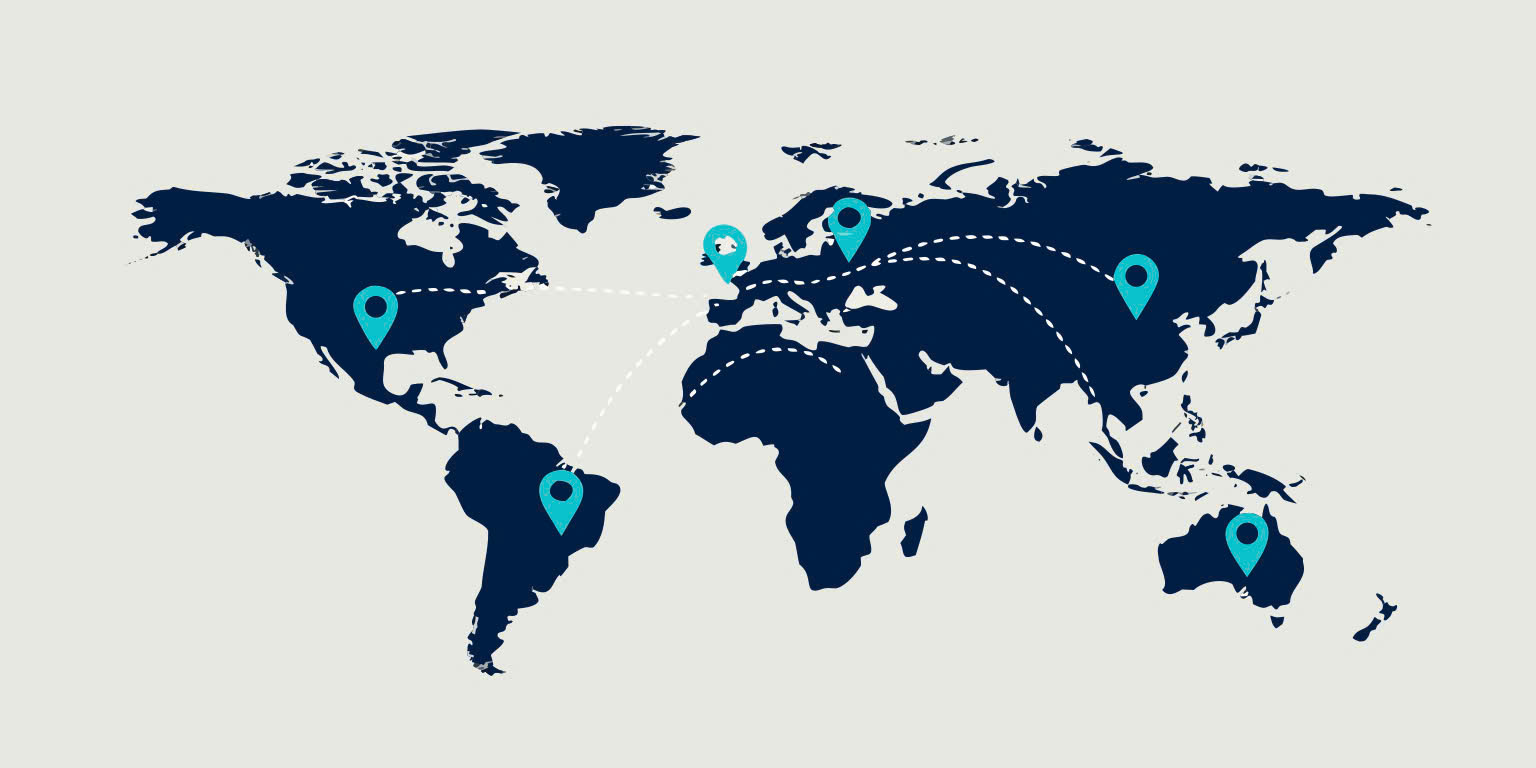
Remote work did not just shift where people work — it restructured who can hire whom. Geographic proximity, which once constrained nearly every hiring decision, now constrains very few. Companies in Frankfurt hire engineers in Lahore. Startups in San Francisco run operations teams out of Nairobi. Marketing agencies in Dubai staff content teams from Manila. This is not a temporary experiment; it is the new default architecture of knowledge-work hiring, and the trends driving it are accelerating.
For employers, this shift creates access to talent markets that did not previously exist in their hiring radius. For candidates, it creates access to opportunities that salary benchmarks and career trajectories in their local market could not have provided. What follows is an overview of the five most significant cross-border remote hiring trends reshaping the global workforce right now.
Trend 1: The Rise of South-to-South Hiring
The dominant narrative about cross-border remote work has historically been North-to-South: US and European companies hiring talent in lower-cost markets. That narrative is now incomplete. South-to-South hiring — companies in the Gulf states, Southeast Asia, and emerging African economies hiring talent from Pakistan, India, the Philippines, and within Africa itself — is one of the fastest-growing corridors in international remote work.
Gulf companies, in particular, have significantly expanded their appetite for remote talent from South and Southeast Asia. Saudi Vision 2030 and UAE economic diversification have created a demand for skilled professionals in technology, finance, and operations that local talent supply cannot fully meet. Remote hiring from Pakistan, India, and Bangladesh fills this gap with candidates who often have strong English fluency, timezone proximity to Gulf working hours, and experience in the industries the region is prioritizing.
For Pakistani, Indian, and Filipino professionals, Gulf-market remote roles represent a compelling combination: near-international compensation without the relocation costs, visa processes, and family disruption of physical migration. The South-to-South corridor is growing because it works well for both sides.
Key Takeaway
Trend 2: African Talent Entering Global Supply Chains
Africa has long had a large and growing pool of skilled professionals in technology, finance, marketing, and operations. What has changed is the infrastructure enabling that talent to connect with global employers: improved internet connectivity, greater familiarity with remote collaboration tools, and an expanding network of African professionals who have demonstrated remote-work credibility to international hiring managers.
Nigerian engineers, Kenyan data analysts, Ivorian and Senegalese developers, and South African finance professionals are increasingly visible in international hiring pipelines. European companies looking to extend coverage into African time zones, and US companies seeking to diversify their talent base, are discovering that the depth of technical talent in African markets — particularly in Nigeria, Kenya, Ghana, and Côte d'Ivoire — is significantly greater than their previous hiring patterns would have suggested.
The challenge has not been talent availability; it has been discoverability. Generic job boards with location filters have systematically excluded African candidates from searches targeting international talent. AI-powered matching platforms that evaluate skill fit independently of geography are beginning to correct this, surfacing African professionals to global employers who would not have found them through traditional sourcing.
Key Takeaway
Trend 3: AI-Powered Matching Replacing Manual Recruiter Sourcing
Traditional international recruitment relied on a small number of specialist recruiters with deep knowledge of specific talent markets. This model has three structural limitations: it does not scale, it has significant geographic and network biases, and it is expensive. A recruiter who knows the Nigerian tech market well typically does not know the Vietnamese market equally well, and running two separate regional sourcing processes for one role is not economical for most companies.
AI-powered matching changes this by evaluating candidates across markets simultaneously against a consistent, skill-based scoring model. The employer's requirements — skills, experience level, language, timezone, engagement type — are matched against a global candidate pool without the recruiter needing deep market knowledge in every geography. This enables smaller companies, which previously could not afford specialist international recruitment, to access global talent pools that were functionally inaccessible to them.
The trend is toward AI handling first-pass screening and shortlisting across geographies, with human judgment applied to the final stages of evaluation. This model is faster, less expensive, and demonstrably less biased by geographic proximity than manual sourcing — which is why adoption is accelerating among companies that have experienced both approaches.
Key Takeaway
Trend 4: Async-First Work Culture Enabling Wider Timezone Coverage
The early phase of remote work largely replicated office-hours norms at a distance: synchronous meetings, real-time chat expectations, and de facto requirements to be online during the hiring company's business hours. This model worked for candidates in adjacent time zones but effectively excluded talent in time zones more than four or five hours from the company's base.
Async-first culture — structuring work around written communication, documentation, and outcome delivery rather than real-time presence — dramatically expands the viable timezone range for a given role. A US company that has genuinely adopted async-first practices can work effectively with a developer in Karachi, a designer in Lagos, or an analyst in Jakarta without requiring those team members to maintain Pacific or Eastern time hours.
Companies that have made this transition report that the productivity and quality of work from their distributed international hires is comparable to — and in some disciplines, higher than — their co-located teams. The adoption of async-first culture is a leading indicator of a company's cross-border hiring readiness, and candidates who evaluate employers on this dimension before applying are better positioned to identify roles where they will actually be set up to succeed.
Key Takeaway
Trend 5: Compliance and Contractor Models Replacing Entity Setup
Historically, hiring internationally meant one of two things: either the employee was required to relocate, or the company set up a local legal entity in the candidate's country. Both options are expensive, slow, and unsuitable for companies that want to hire one or two people in a given market rather than establish a permanent presence.
Two alternative models have emerged that make cross-border hiring practical at smaller scale: independent contractor engagement and employer-of-record (EOR) services. The contractor model — engaging a professional as an independent contractor under a service agreement — requires no local entity, moves quickly, and is well-suited to project-based or specialist work. The EOR model — using a third-party company that employs the worker locally on the hiring company's behalf — is better suited to longer-term, full-time arrangements where employee status is preferred or legally required.
Both models have matured significantly. Cross-border payment infrastructure (Wise, Payoneer, Deel, Remote.com) has made international contractor payments routine. EOR providers now operate in most major talent markets. The compliance overhead that once made small-scale international hiring impractical has been reduced to the point where a ten-person startup can maintain a distributed team across five countries without a dedicated legal or HR function.
Key Takeaway
How JobConnect AI Fits Into These Trends
JobConnect AI is built for the cross-border hiring landscape these five trends are creating. Our AI matching engine evaluates candidates and roles against a consistent, skill-based model — not a geographic filter — surfacing the strongest matches across global talent markets simultaneously. Employer profiles indicate cross-border hiring readiness, so candidates can identify companies that have the infrastructure to hire them, not just the intention.
For employers, JobConnect AI provides access to talent pools in Africa, South Asia, Southeast Asia, and beyond that traditional sourcing channels systematically underrepresent. For candidates in these markets, it provides visibility to global employers who are actively looking for the skills they have. The platform is designed around the reality that the best hire for a given role is frequently not the closest one — it is the one that AI matching finds first.
Frequently Asked Questions
What is cross-border remote hiring?
Cross-border remote hiring refers to the practice of engaging employees or contractors who work remotely from a country different from the hiring company's base of operations. It encompasses the full spectrum of international talent acquisition: from US companies hiring contractors in Southeast Asia to Gulf employers sourcing remote developers from South Asia to European startups building distributed teams across Africa and Eastern Europe.
How is AI changing international talent acquisition?
AI is shifting international talent acquisition from a network-dependent, geography-constrained process to a skills-first, global-scale one. Where traditional international recruitment relied on specialist recruiters with deep knowledge of specific talent markets — an expensive and limited model — AI-powered matching evaluates candidates across all geographies simultaneously against a consistent skill-based model. This makes global talent pools accessible to companies that previously could not afford or access specialist international sourcing, and it surfaces candidates who would have been invisible in traditional location-filtered searches.
Related employer resources
Cross-border remote hiring is not a niche practice or a temporary response to supply constraints — it is the direction global knowledge work is moving. Companies that build the infrastructure, processes, and culture to hire across borders now are positioning themselves for a talent market that is increasingly global by default. The five trends above are not predictions; they are descriptions of what is already happening at scale in international hiring pipelines. The question for employers is not whether to participate in cross-border hiring, but how quickly to build the capability to do it well.